
Photo of the Month #35 (September 2026 Edition): The beginning of everything
I have been intensely dedicated to the Magnetosphere series, a collection of black and white photographs of the northern and Southern lights. The idea behind this series is to reveal the patterns, shapes, textures, and flow of the invisible magnetic field that protects the planet’s surface and life from solar radiation. With this body of work, I seek to show that, even stripped of their colors, the auroras remain one of the most fascinating natural phenomena in our Solar System.
Although they are a manifestation of Earth’s magnetic field, auroras actually begin on the Sun. When electrically charged particles from the solar wind collide with Earth’s atmosphere, the gases emit light. These particles become trapped within the magnetosphere, which guides them toward the planet’s polar regions, creating those fascinating displays of light. Photographing auroras is relatively straightforward in polar regions or even at mid-latitudes. But the only ways to photograph the solar atmosphere from which these particles originate, known as the corona, are with highly sophisticated equipment or during total solar eclipses, such as the one on August 12, 2026. So, I could not miss the opportunity.
The eclipse was quite brief, but incredibly exciting. After photographing the corona during the few seconds of totality, which were necessary to complete the Magnetosphere series, I had a few brief moments left to experiment. I knew I would see thousands of photographs similar to the one I had taken, since that was what many other people were also hoping to make. So, with the photo secured and the first rays of sunlight already emerging from the Moon’s shadow, I began stopping down the aperture and seeing what happened with different exposure times.
The light was changing extremely quickly, leaving little time for testing. After my first attempts, observing the subtle effect of the rays of light, I stopped down all the way to f/54, increased the exposure time to compensate for the shadows, and pressed the shutter. I made a few more exposure adjustments, racing against the speed of light. Finally, after several variations, I arrived at the image I liked most from that moment. Totality had already passed, but the technical experimentation, quite a risky endeavor in those few seconds, succeeded in capturing the representation I was looking for.
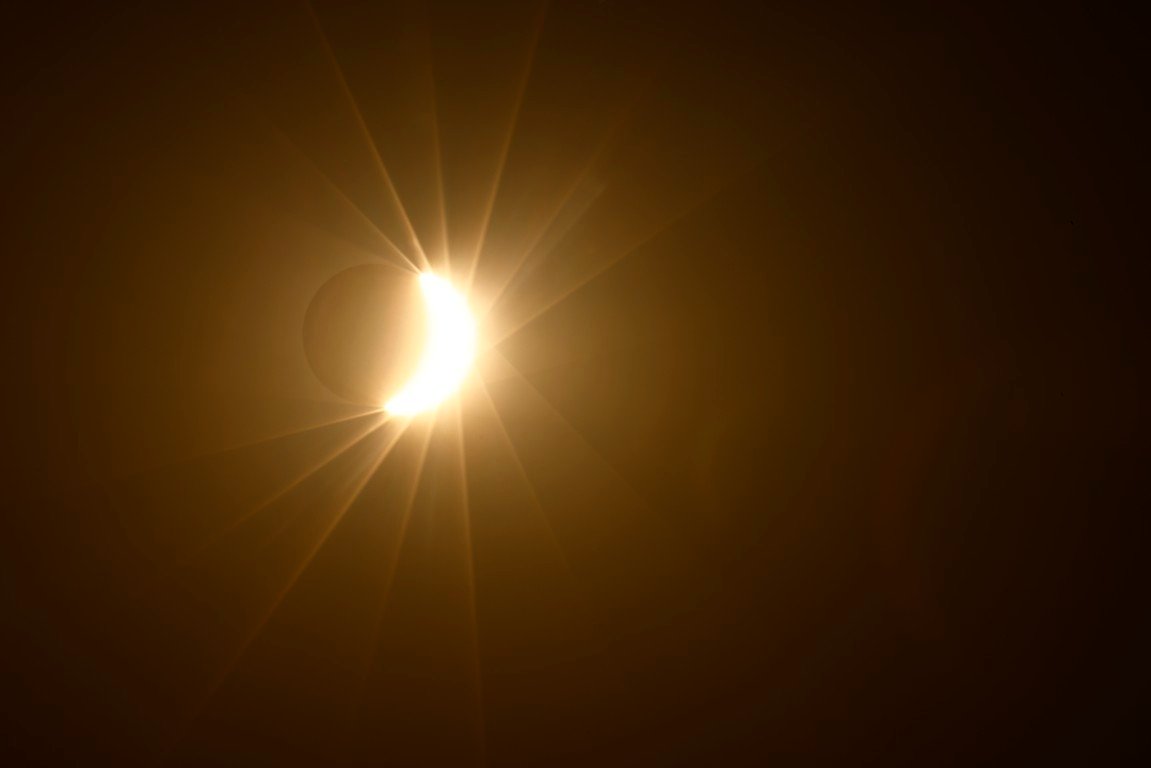
And so the “photo of the month” was born, with the final missing piece needed to complete the Magnetosphere series. Ironically, I needed a photograph of the Sun, absent during the moments when the aurora glow can be seen. And, even more fittingly, the beginning of everything arrived at the end to illuminate the series. And all the light needed came straight from a shadow.