
Photo of the Month (June 2026 Edition): Your flight has been cancelled
In two previous texts (here and here) I recounted my experience at the Photo London photography art fair, which took place in mid-May, and with this text I will conclude the trilogy. Naturally, the fair is held in the English capital, and to get there from northern Scotland, where I am spending some time as an honorary researcher at the University of Aberdeen, the fastest and cheapest way is, unfortunately, by air.
Aberdeen is a port city, built of granite and with an economy focused on offshore activities, especially those involving oil and hydrogen. According to the Köppen classification, its climate is temperate oceanic (Cfb), but according to my own classification, it is unhealthy, with a biting wind. Rain and cold are constant, even during the period called summer, which is just beginning now. Because it lies so far north, at approximately latitude 57°, spring and summer nights are bright, but they are also prone to displays of the Northern Lights.
For that reason, as soon as I arrived in the city at the end of April, I began monitoring solar activity in the hope of seeing an aurora. But with the sky frequently overcast, I kept my expectations in check and stopped following the solar forecasts. Then, the day before my flight to London for the fair, the sky finally cleared. I looked up the aurora forecast and, sure enough, a significant solar eruption had been recorded, with the potential to color the skies over northern Scotland… the following day, precisely when I was supposed to be in London.
On the day I saw the alert, the weather turned bad again, and with the cold as intense as it was, I did not dare go out to try my luck. But the next morning I received an email informing me that my flight had been canceled and offering me a seat on a flight the following day instead. At first I was furious, but then I realized I would miss neither Photo London nor that night’s auroras, and it suddenly seemed like a good deal.
I worked as usual on the day I was supposed to be in London and, early in the evening, headed to the entrance of Aberdeen’s harbor to avoid the city’s light pollution. However, ship traffic was so heavy that it was almost worse than the glow of the city lights in the distance. To make matters worse, there were clouds, rain, and wind, lots and lots of wind, enough to shake the tripod and blur many photographs that otherwise seemed promising.
Already tired of the icy, damp wind in my face and seeing nothing but clouds overhead, I was on the verge of giving up. Around half past midnight, the clouds began to break apart, though the horizon remained bright. And of course it would stay bright for the rest of the night. I took a test shot of the sky to see whether there was any unusual activity, already thinking about heading home. But between the clouds there seemed to be a blue column, and I had no choice but to wait for the sky to open further.
The clouds never completely dissipated, but they drifted over the horizon, which was already beginning to brighten. The lights from the ships illuminated the harbor breakwater on one side, while the city lights cast a glow on the charming lighthouse on the other. And for more than an hour, the magnetosphere lit up the slightly darker portion of the sky, with auroras visible to the naked eye above the city. Just above the clouds there was a constant layer of green aurora, occasionally tinged with purple. From time to time, blue and violet columns appearing gray to the human eye, swept higher across the sky.
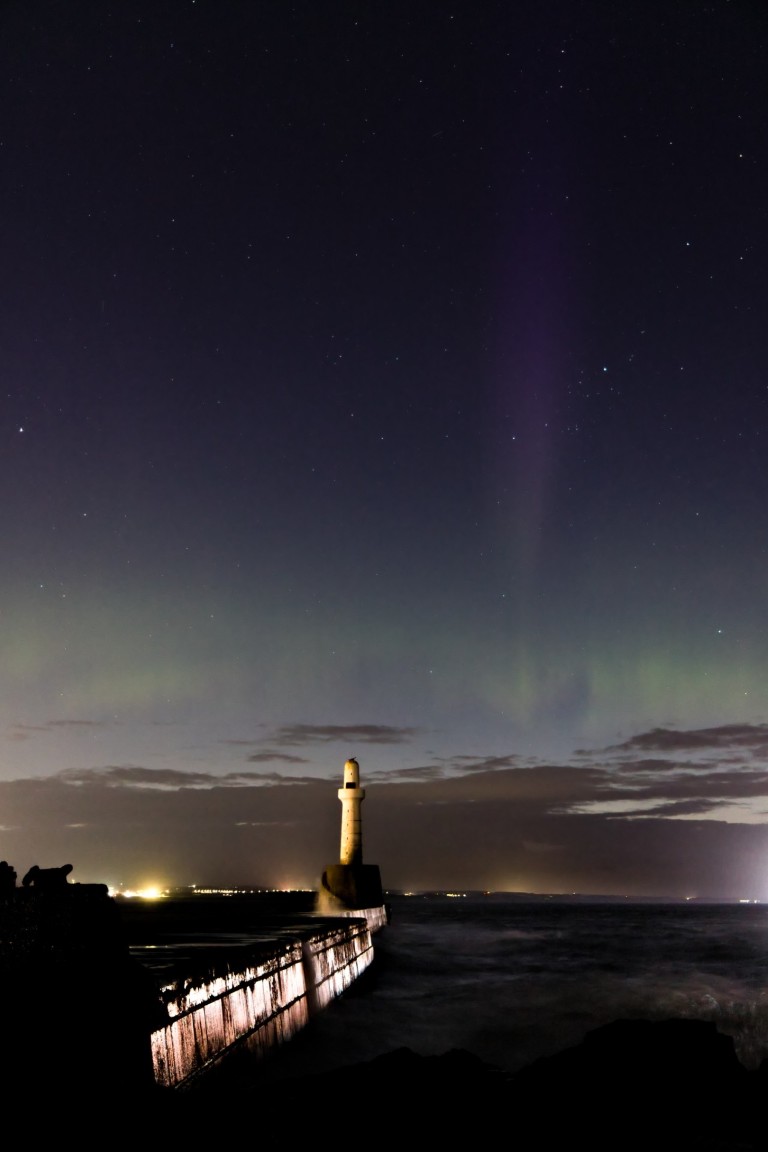
And so, the brightness of the landscape, the brightness of the sky, and the relentless wind combined to make this one of the most difficult auroras I have ever photographed. Shortly before 2:30 a.m., the sky had become so bright that photographing the aurora was nearly impossible, even though it was still visible. I finally decided to face the forty-minute walk home. I arrived with the spring sky already glowing brightly and the dread of having to catch the airport bus just a few poorly rested hours later. I woke up exhausted and spent the day fighting sleep, but those nearly two hours beneath the auroras more than compensated for that canceled ninety-minute flight, and always will.