
First time in a photographic art fair – Photo London 2026
This May, I had the opportunity to attend a photographic art fair for the first time. Photo London is not a festival like the ones I am used to and truly enjoy attending. Nor is it a space with multiple exhibitions happening simultaneously. It is a photography art fair, in other words, a place for business.
In its eleventh edition, the fair took place from May 14 to 17, 2026, at the Olympia event centre in West London. It was the first time the fair had been held at this venue, featuring more space, more galleries, more publishers, more artists, and more books for sale than in previous editions.
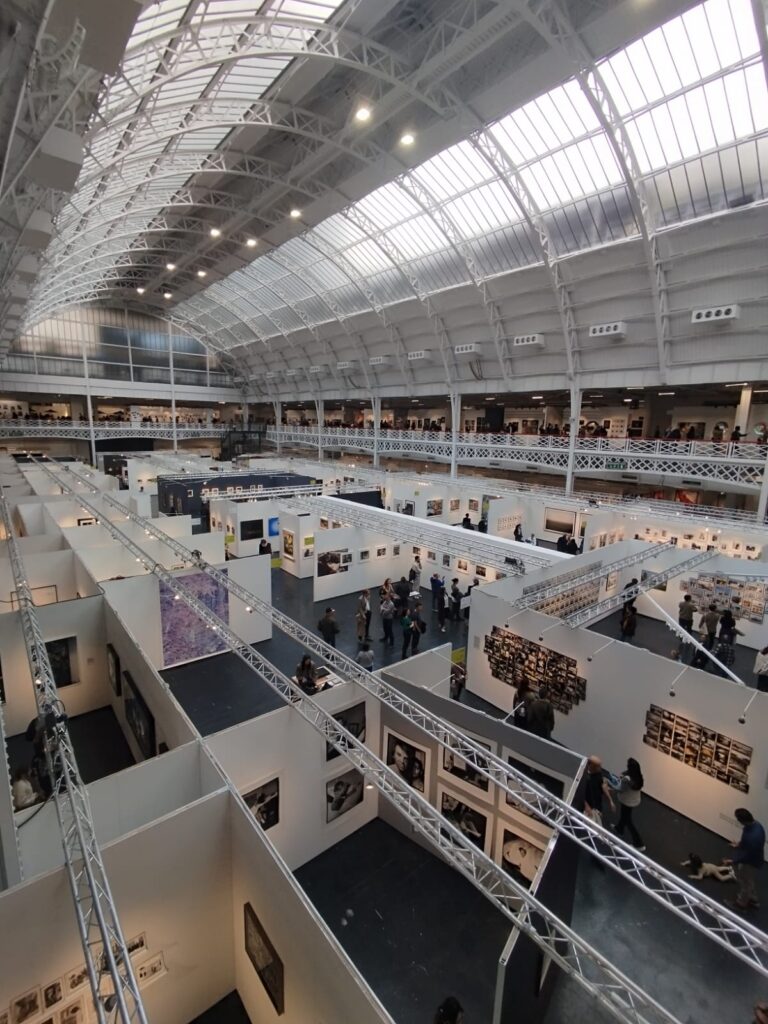
Overview of the fair
And all of that comes at a cost… or rather, a filter. A single-day ticket cost £32 (nearly R$220), considered quite expensive even for those living in notoriously pricey London. This leaves little doubt that the fair is not intended to be inclusive, democratic, or open to newcomers eager to discover photography as an art form. On the contrary, it is hermetic and optimised for sales.
According to Sophie Parker, the fair’s director since 2024, one of photography’s main attractions lies in its accessibility for collectors. Indeed, the prices of the most expensive photographs ever sold at auction pale in comparison to those of history’s most expensive paintings. In a global art market that is shrinking in financial volume while increasing in the number of works traded, limited-edition photographs may emerge as important vehicles for financial speculation.
The more affordable works at the fair came in larger editions (between 30 and 50 prints), in smaller formats (close to A4 size), starting at around £100. Meanwhile, the average price of more exclusive editions (between 5 and 15 prints), in more suitable dimensions of around 45 x 60 cm, hovered around £3,000 (over R$20,000 at the time of writing). For the billion-dollar art market which I, and probably you reading this, do not belong to, these prices remain relatively low compared to those found in other artistic spheres, such as painting.
Beyond prices, attending an event like this offers a unique opportunity to observe, study, and understand what is at the forefront of the market, and therefore, of global trends. Since narratives are what define contemporary art, photography is no exception within this global commercial framework. Much of the fair, as well as its promotional material, revolved around visual narratives, whether explicit or implied, materialised in everyday portraits (laden with intimate stories revealed through curatorial texts), performances, quests for self-identity, staged cinematic scenarios, and renewed interest in works created decades ago by artists already well established in the market but not only exhibited now.
There were also some bolder initiatives, featuring images entirely generated by machine-learning models, alongside their “lens-based” counterpart: photographs that until recently would have been considered technically imperfect. Here, dust on a camera sensor, amplified in a landscape image over a metre wide, can serve as a kind of captcha, certifying the human quality of the work.
Amid all this, there are incredibly powerful stories and remarkable documentary works, such as those of Jane Evelyn Atwood, who photographed women in prison systems across Europe and the United States, and the activist photojournalism of Misan Harriman focused on Black lives, among many others. What remains surprising, however, is the search for narratives where they never truly existed, perhaps best exemplified by fashion photographs produced exclusively for Vogue in studio settings during the 1990s. In some cases, the effort of curatorial texts to persuade viewers of a deeper message behind the photographs becomes so intense that it unintentionally reveals the opportunism of repackaging recycled work in luxury wrapping.
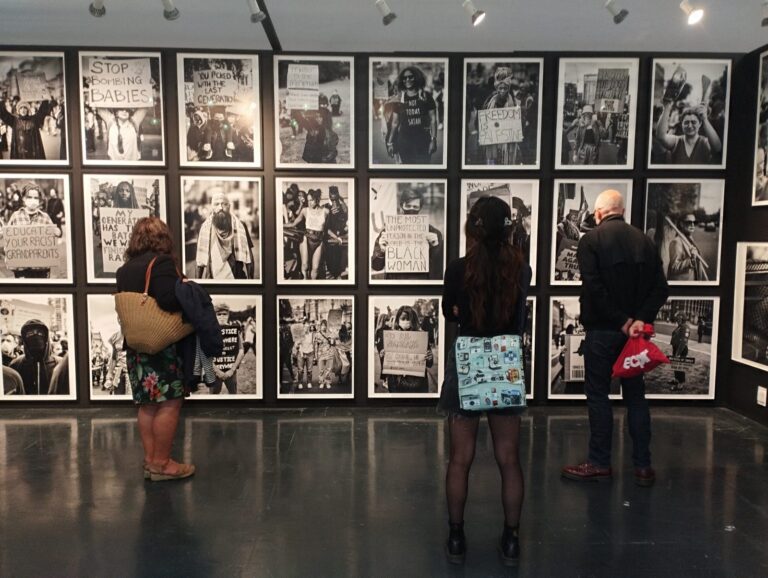
The work of Misan Harriman exhibited during Photo London 2026
After all, participating in a fair like this is astronomically more expensive for a gallery than for a curious photographer like myself. There are costs for renting the booth, installation, transportation of artworks, insurance, accommodation, staff meals, and much more, leaving little room for mistakes. As a result, betting on already established names, with recognised and accepted bodies of work, while focusing on conventional contemporary photographic practices, becomes a way of reducing business risk.
I cannot say whether the fair met the galleries’ commercial expectations, but by the penultimate day I had already seen many works marked as sold, several negotiations in progress, and reports from galleries claiming sales of £100,000 (nearly R$700,000) from only three works on the very first day. Because of this, and judging by the apparent overcrowding of the VIP lounge reserved for collectors, I tend to believe the fair was indeed successful in achieving its objectives. That likely means even larger editions in the years ahead, further consolidating contemporary photography within the broader art market circuit.
Still, with over one hundred galleries and fifty publishers gathered under the same roof, business mattered little to me. I went to understand the market, yes, but even more so to discover new work and physically experience things I would otherwise rarely have the chance to see outside a digital screen. And I can say I was pleasantly surprised to discover that even within the highly selective world of contemporary photography, there is still some room for more traditional documentary practices and environmental themes, the very things that first drew me to photography as a technique, and later as a form of expression.
The environmental works I most enjoyed seeing in person will receive a dedicated post here on the blog next month. For now, it is enough to say that attending Photo London was worth every one of those £32, roughly the price I would pay for a good photography book in Brazil. But no book could have taught me as much about how the art market works as being there in person: watching negotiations unfold and gaining a clearer understanding of the direction art is taking. I admit I left exhausted after so many exhibitions and so many people, but also satisfied and full of ideas. I wholeheartedly recommend the experience, because a fair of this scale bears absolutely no resemblance to the beloved photography festivals I know, events organised with far more passion than money.