
Blast from the Past #2: The Night Sky Belongs to Us!
More and more, the night sky has been appearing in the news, whether because of the beautiful explosions of polar auroras, or because of the greed of a few billionaires who, with their thousands of small satellites, are putting at risk the study of the deep universe, systems for observing and monitoring meteors, and even the very launch of new space missions.
The infinity surrounding Earth has been getting sealed off, especially over the past five years. All of this has happened without an international legal framework to regulate space operations, much less any sharing of information between state and private agencies. This lack of rules for space operations almost resulted in a collision between a CAS Space spacecraft and a Starlink satellite in December 2025. The two objects passed just 200 meters apart in an orbit 560 km above Earth.
From an operational standpoint, the problem is not necessarily the number of satellites, but rather their uncertain trajectories. It is estimated that Starlink satellites are making about four safety maneuvers per month to avoid collisions in space! This means that every week the map of objects in orbit changes, imposing unpredictability and great uncertainty on future space projects.
From a humanitarian point of view, we have lost the right to a night sky free of pollution, whether light pollution from Earth or from space itself, flooded with terrestrial artifacts that shine at night.
For me, the most frightening thing has been the pace of this process. I remember, as a teenager some twenty years ago, enjoying tracking the passes of the International Space Station (ISS) or one of the 66 satellites in the Iridium telecommunications constellation. Because of their characteristics, these objects were visible to the naked eye about 40 minutes after sunset, and spotting them was therefore an eagerly anticipated and planned event. It was much harder to see a satellite pass in a completely dark sky, and even then its brightness was very faint. Now, you just have to look up at any time of night and sooner or later there will be a streak of light crawling across the vault of the heavens, ruining some photo of the Milky Way or the feeling that there are still spaces free from anthropocentric disputes.
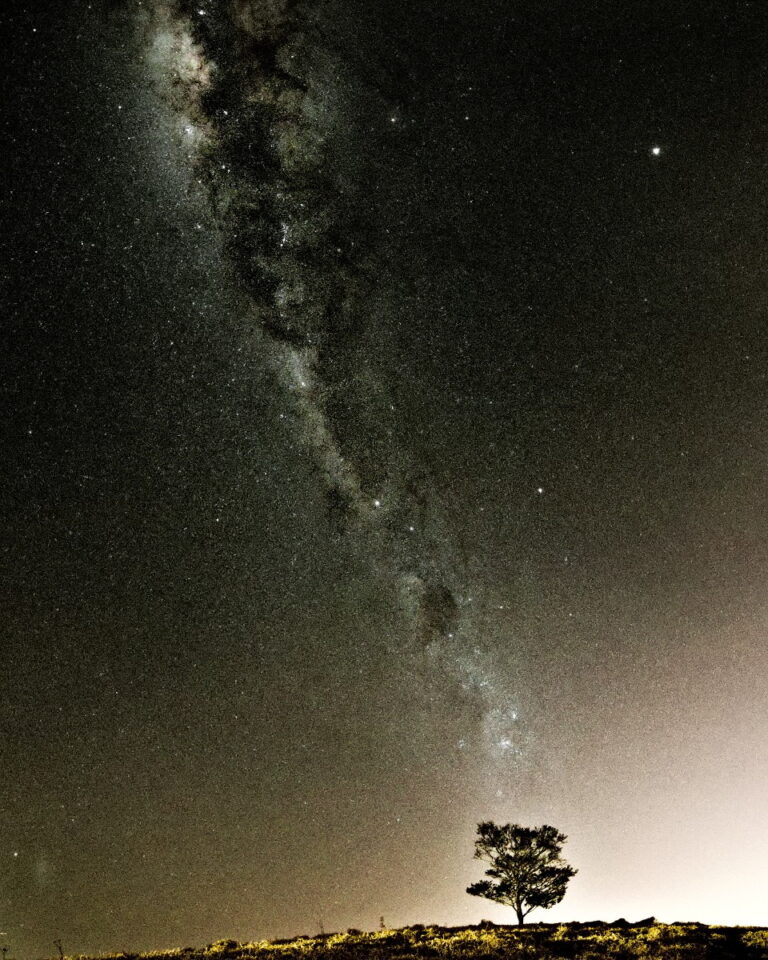
I bring back this photo taken in Caçapava (SP), in July 2018, in the context of the dispute between Starlink and CAS Space, at a time when Europe is planning to rival the satellite-internet race with Musk and SpaceSail plans to have 15,000 communication satellites in orbit in less than five years. This photo is a vertical panorama composed of four horizontal photos, in which the light pollution from the city of São José dos Campos was used as a resource to isolate an element of the landscape, the small tree in a pasture at the top of a hill.
To take this photo I didn’t have to fight against thousands of satellites. That’s why I used it as part of the #saveournightsky campaign, an international mobilization in the middle of the COVID-19 pandemic (in 2020). At the time, the campaign still referred to Starlink’s earliest plans to dominate space. The reaction was huge, it was my only photo to “go viral” on Instagram (with more than 700 “organic” likes), but we lost the battle. Unfortunately, taking photos like this is becoming increasingly difficult, and now only hope and continued mobilization remain so that it does not become impossible in the very near future.
Below, I reproduce the text that accompanied the photo on Instagram (translated from Brazilian):
The night sky may be one of the elements of nature that has most fascinated human beings throughout their natural history. Whether out of fear, appreciation, navigation, or science, every form of civilization developed deep knowledge of astronomy and based much of its activity on it. But it was only in the twentieth century that humanity could leave its home to see it from the outside. Since then, every space mission has left some kind of debris in space, and it is estimated that there are about 330 million pieces larger than 1 mm orbiting Earth right now. Space missions and satellites in orbit are essential for us to better understand our terrestrial environment, as well as to improve global communications. That is why the U.S. company SpaceX decided to launch a worldwide satellite broadband project called Starlink, with 422 satellites launched since last year, which are often seen with the naked eye forming real lines of bright objects flying over the globe. The company expects to reach 40,000 satellites, and the sky over a rural area will resemble the surroundings of an airport! In this sense, the International Astronomical Union has already warned about the profound negative impact of this satellite constellation on astronomical studies, because they are very bright. The company announced it will try to reduce the satellites’ luminosity (a measure that has already proven to be of little effect, with only a 55% reduction in brightness), but even so this project imposes on the whole world an unprecedented interference in the contemplation and study of the night sky, potentially even preventing scientific research that depends on observing objects beyond Neptune’s orbit, as well as compromising the search for asteroids heading toward our planet. Other companies such as OneWeb and Amazon also have similar projects, but with fewer satellites. Thus, our beautiful night sky will be harmed not only by light pollution from Earth, but by space being occupied by these companies without the consent of humanity.